Innovation in Addiction Medicine Summit
This three-day event, delivered from 22-24 September 2025, was designed to strengthen the University’s role in advancing innovation in addiction medicine and to position St Andrews as a global leader in translating research into measurable health system impact.
Researchers and leaders from the University, government, academia, healthcare and industry convened to share insights, identify synergies, and catalyse investment in systemic transformation.
While the initiative was anchored in addiction medicine, its core focus was innovation co-created with experts across organisations, communities, and disciplines. The programme was designed to share expertise in an interdisciplinary setting, help shape a national model for innovation, and contribute to the development of the IDEAS in Addiction Medicine St Andrews – generating real-world impact and foster new opportunities for research, collaboration, and leadership aligned with identified priorities.
The programme is closely aligned with the University Strategy, fostering a culture of innovation to deliver maximum social benefit. Through these events, we aim to strengthen collaboration and generate solutions that reflect the University’s strategic themes:

Overview of the Summit programme
Day 1: International perspectives
35 people joined us in person, and 140 online, to welcome two disinguished speakers to deliver keynote presentation on international perspectives on innovation in addiction medicine.

Dr Hamed Ekhtiari, University of Minnesota
Bridging the Gap: Innovation Needs and Opportunities in Addiction Medicine in the Era of Neuroscience and AI
Innovation in addiction medicine must be (1) cutting edge and globally informed and meanwhile (2) resources/culturally mindful and locally grounded. In this keynote, Dr Ekhtiari explored the critical areas where innovation is urgently needed – from prevention and diagnosis to treatment and recovery – and how global insights and cutting edge advances in neuroscience and AI can guide context-sensitive solutions. Dr Ekhtiari highlighted the importance of collaboration across disciplines, sectors, and borders, emphasizing that universities alone cannot drive meaningful change. By bridging academic research with health systems, communities, and international networks, Dr. Ekhtiari outlined a roadmap for identifying innovation opportunities that are cutting-edge, scalable, inclusive, and impactful. This talk invited stakeholders to co-create solutions that reflect both global best practices and local realities.
Download Dr Ekhtiri’s presentation
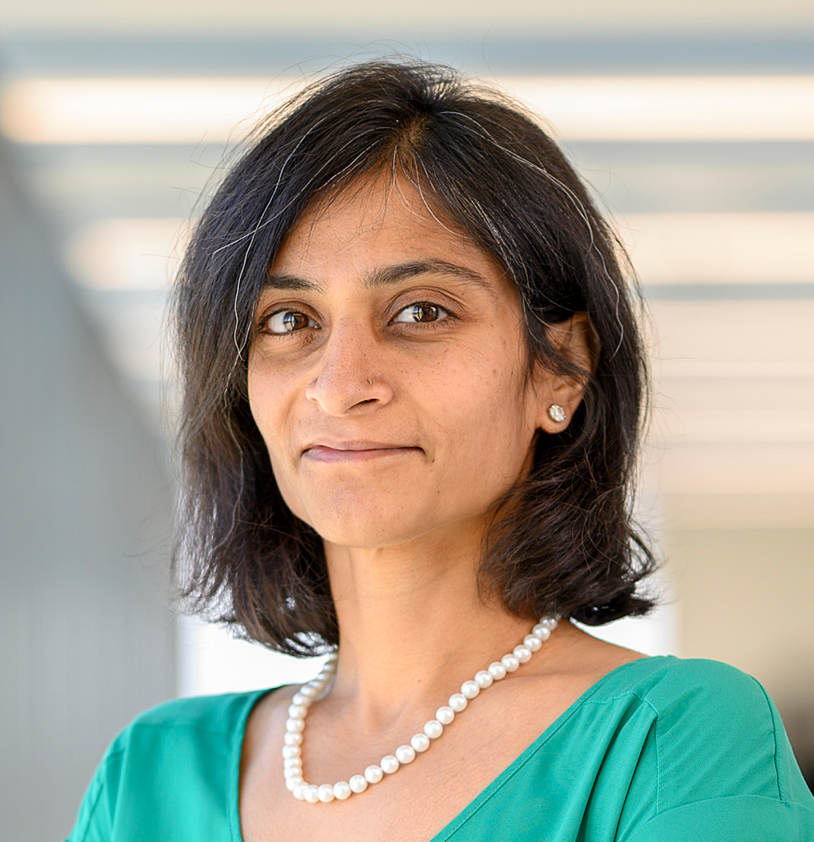
Dr Supriya Munshaw, Johns Hopkins Carey Business School
Creating Value in Addiction Medicine: The Journey from Discovery to Impact
How can universities and other key stakeholders move beyond the lab to create real-worldimpact in addiction medicine? In this keynote, Dr Munshaw explored the power of ecosystems – spanning business schools, commercialization offices, investors, healthsystems, and interdisciplinary partnerships in supporting researchers on the journey fromdiscovery to impact. She highlighted how entrepreneurship enables innovations to reach those who need them most, and how to create value to ensure sustainability and equity. Crucially, the talk addressed why researchers cannot do this alone, and how strategic engagement with their universities, health systems, funders, and users is essential to build scalable, sustainable solutions. Through examples of success, failure, and lessons learned, Dr. Munshaw offer practical insights into importance of embedding business education to empower academic innovators.
Download Dr Munshaw’s presentation

Day 2: Summit day
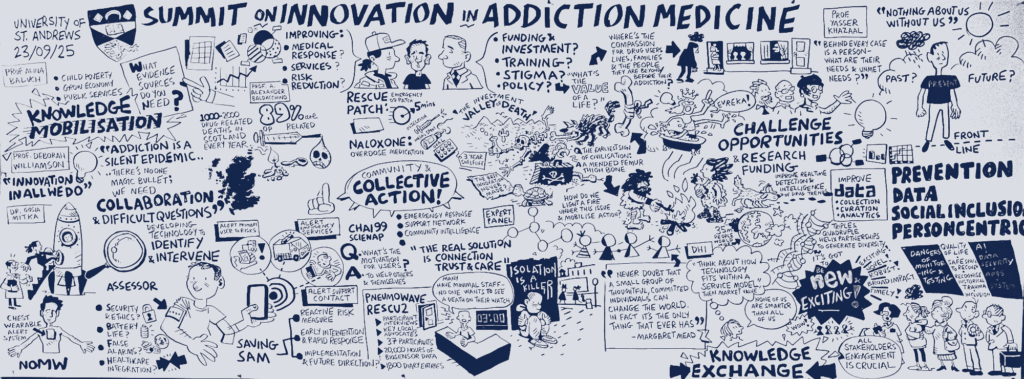
This day convened leaders and researchers from across the University with NHS, government, and industry partners to explore collaboration opportunities around imminent MedTech innovation funding calls.
The Summit commenced with opening remarks from Derek watson (Chief Executive Officer, St Andrews Innovation), Professor Alina Baluch (Vice Dean Research and Impact, University of St Andrews Business School), and Professor Deborah Williams (Dean, School of Medicine).
In an innovation showcase session, leads from seven projects shared their experiences and learning from a unique, UK-wide, four-year publicly funded programme aimed at reducing drug deaths, demonstrating the realworld impact of translating research into practice. These included:
- ASSESSOR. Dr Alberto Oteo Perez, University of Glasgow
- Saving SAM. Dr Claire Ann Banga, eMoodie
- LifeSavr. Ayub Shoaib , NOMW Health
- ALERT. Dr Osian Meredith , PNEUMOWAVE
- CHAI999. Philippa Morgan-Jones, SCIENAP
- Ultra-portable fast-dispersal buccal naloxone for constant carriage. Mariana Gonzalez Utrilla, King’s College London
- RescuePatch. Ali Al-khattawi, MESOX
An expert panel session allowed Summit participants to explore issues raised by the project leads in discussion with:
- Professor Peter Donnelly, Professor of Public Health, University of St Andrews
- Dr Fiona Schaeffer, Innovation Commercialisation Manager, InnoScot Health
- Professor Anna Brattström, Chair of Entrepreneurship, University of St Andrews Business School
- Dr Roger Flint, Founder & Chief Executive Officer, The Safer Prescription of Opioids Tool
- Gemma Lee, Innovation Specialist, Scottish Enterprise
The afternoon included sessions and activities designed to stimulate participants to generate new collaborative ideas for a joint funding application in response to imminent MedTech innovation calls.
Moira Mackenzie (Deputy Chief Executive Officer/Director of Innovation, Digital Health and Care Innovation Centre) and Dr Lorna Nisbet (Senior Lecturer, Leverhulme Research Centre for Forensic Science, University of Dundee) described recent initiatives to inform, drive, and evaluate innovation in responses to drug harms across Scotland.
Dr Dagmar der Weduwen and Dr David Stevenson (St Andrews Innovation) outlined emerging strategic funding opportunities and facilitated sandpit activities that strengthened relationships, identified opportunities, and developed research questions to inform collaborative bids.
Professor Yasser Khazaal (Université de Lausanne and World Health Organisation Addiction Medicine Innovation) gave closing remarks.
Day 3: Innovation Incubator
The final day engaged leaders and researchers from the University of St Andrews, University of Minnesota (Dr Hamed Ekhtiari), Université de Lausanne and World Health Organisation (Professor Yasser Khazaal), and NHS Fife (Dr Susanna Galea-Singer). Local academic participants included Directors of Research, senior lecturers, and principal investigators from:
- University of St Andrews Business School
- School of Computer Science
- School of Geography and Sustaintable Development
- School of Mathematics and Statistics
- School of Physics and Astronomy
- School of Psychology and Neuroscience
- School of Medicine
- St Andrews Innovation
Objectives for the incubator session were to:
- Serve as a decision incubator for translating the insights from Days 1 and 2 into operating model choices on the Hub’s scope, structure, and first-year priorities.
- Co-create the blueprint for IDEAS in Addiction Medicine by moving from incremental talk to concrete shared vision and a collective timeline.
- Identify strategic priorities that maximise patient outcomes and system value.
- Confirm commitments, ownership, and next steps for implementation.
Through collaborative futures exercises, participants identified a set of strategic pillars, a roadmap to 2030, operating models, and early priorities.
